An ongoing illustrative history study
This piece originally posted on 02/15/2026,
Black History Month 2026
Prelude | 207 | 208 | 209 | 210 | 211 | 212 | 213 | 214 | 215 | Email |
|---|
"Had Ethel Payne not been black, she certainly would have been one of the most recognized journalists in American society."
--The Washington Post, in a 1991 editorial
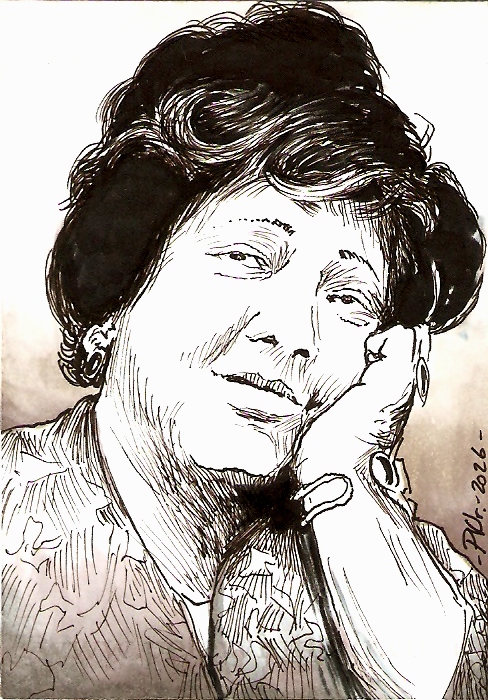
As a companion piece to the prior lessons of Alice Dunnigan and Harry McAlpin, today we look at the accomplishments of Ethel Payne, the "First Lady of the Black Press." While McAlpin was the first Black journalist to actually cover the White House and Dunnigan was the first Black woman journalist in that role, Payne was the first Black journalist to formally join the actual White House Press Corps.
Born in 1911 Chicago, Ethel was a compulsive reader --and writer and journaller-- from a very early age. Literacy was heavily emphasized in her household; her mother Bessie had been a Latin teacher. She graduated from Garrett Biblical Institute in 1933 and originally pursued a career as a lawyer, but The University of Chicago Law School would not accept her application due to her race. In 1948, while working as a hostess at an Army Special Services club in Japan, she was encouraged by war reporter Alex Wilson from the Chicago Defender to share her journal, which was a detailed account of her own observations of the lives (and conditions) of Black soldiers stationed in Japan; particularly Gen. MacArthur's conspicuous refusal to desegregate the troops. Wilson was suitably impressed at Payne's uncomplicated-yet-emotional wordmanship, and in turn shared some of her journal writings with the Defender. This may well have been Fate, as Payne's father William, himself a child of formerly enslaved people, had been a Pullman Car Porter (expounded upon in Lessons #68 and #69 in this series), an organization that had made a point of surreptitiously leaving copies of the Defender in train cars. By 1951 Ethel was working full-time at the Defender, and in 1952 moved to Washington, D.C. She was invited to join the White House Press Corps in 1955.
Payne's "beat" ranged all over: from the Korean War to Civil Rights --including in-depth coverage of the Montgomery Bus Boycott, school desegregations, and even landed an interview with Martin Luther King Jr. Like Dunnigan before her, Payne famously asked tough questions of Pres. Eisenhower; significantly in July of 1954 she posed a challenging question about ending segregation in interstate travel (itself a pointed reference to the snail's pace at which many institutions were grudgingly bringing themselves into compliance with Brown v. Board of Education); again Eisenhower bristled and angrily asserted that the equal treatment for Black Americans was, in fact, privileged "special interest" treatment. Professionally Payne's boldness bore a cost --she was never again called on by Eisenhower, and the then-White House Press Secretary even opened a petty investigation into her tax records and tried to invalidate her credentials. (Nice to know our national leaders are well past this mindset, huh, folks?)
Undeterred, Payne eventually brought her talents to radio, and then to television, as the first Black woman commentator on a national network (in this case, CBS), in 1972. One of her greatest achievements was spearheading a series "The South at the Crossroads," an analysis of the South during the Civil Rights movement, which brought her work into a much broader public view. She also covered a great deal of overseas stories, all over Africa and also Vietnam --one of her features being a particularly heartwrenching account of exposure to Agent Orange. She retired from the profession in 1978 but taught Journalism at Fisk University for a time. In 2019 the National Association of Black Journalists (NABJ, mentioned previously in Lessons 209 and 210) instituted the Ethel Payne Fellowship, awarded to exceptional foreign (specifically Africa-assigned) correspondents. In 2022 the White House Correspondents' Association formally renamed the lectern in the White House Press Room in her and Dunnigan's honor.
Next lesson - Lesson 212: Gordon Parks