An ongoing illustrative history study
This piece originally posted on 08/20/2026
Prelude | 225 | 226 | 227 | 228 | 229 | 230 | 231 | 232 | 233 | Email |
|---|
"We want... our rights as citizens, and we demand the respect due reputable human beings the world over. What right has the white man of American to insult and humiliate us?"
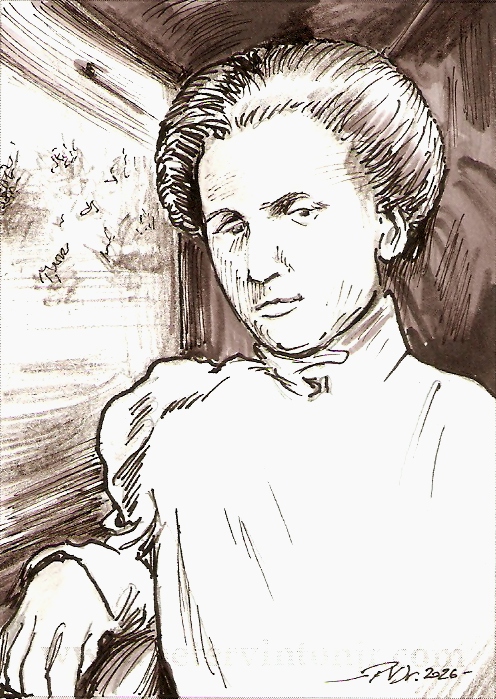
Whatever you're drinking, I want everybody take a moment --and I do mean right now-- to pour one out for D.C. native Barbara E. Pope: high school teacher, author, and activist. Born free in Georgetown, Washington, D.C. in 1854, Barbara's father Alfred was himself formerly enslaved, one of those who made the brave (though unsuccessful) 1848 attempt to escape enslavement aboard the schooner Pearl.
Thus instilled in a family legacy (of sorts), Barbara became a teacher at an unusually early age (sixteen), partly at the encouragement of her own family. Among her peers at the Colored Schools of Washington and Georgetown were Otelia Cromwell (subject of Lesson #167 in this series) and Anna Haywood Cooper (covered in Lesson #149), as well as Booker T. Washington, who had been a friend of her father Alfred. In fact at Washington's behest she taught for one year at the prestigious Tuskegee Normal Institute in Alabama, but then returned to D.C. Despite her celebrated role and status, a particular incident in 1888 got in the way of her professional career --a student kicked her in the abdomen and she expelled that student from the classroom, refusing to readmit him until she got an apology, even after the Board of Trustees ordered her to readmit the troublemaker. Rather than endure any insincerity, Pope resigned, and a scathing editorial in the Washington Bee took the side of the Trustees, marring her reputation and using words like "unreasonable" and "misguided." (At least the word "uppity" wasn't deployed...)
Additionally, Pope turned out prolific short stories --mostly fiction, one of the most memorable being "The New Woman," which first appeared in the highly-regarded Waverly Magazine in 1896. The story presented a bourgeois, educated, professional couple: Margaret and Frank, opening a business together as full partners --and though the narrative does not overtly describe them as such, there are coded contextual clues throughout the story that make it very obvious that this couple is indeed Black; moreover Frank does not display any of the expected patronizing attitude toward Margaret, as might be typical of men when faced with female competence. The literary review Broad Ax praised Pope's storytelling and declared her "A New Literary Star." Such was her talent that it caught the attention of W. E. B. Du Bois, who picked this and three other of Pope's stories (all from Waverly) to represent superlative examples of Black authorship at the Paris Exposition Universelle in 1900. In fact Du Bois pointed to this very exhibit as a precursor argument to the Niagra Movement's first intended legal challenge to interstate segregation laws... something which would soon take on extremely personal significance for Barbara, who was among the Movement's first women members.
In 1906, Barbara boarded a train at Union Station, D.C., bound for a accustomed family vacation spot in Loudon, Virginia, but was directed to the so-called "colored compartment," a cramped and poorly-kept option. Refusing this indignity, she instead sat in the main compartment. The train crossed the Potomac and a white conductor demanded she move; she again refused. The train came to a stop and Barbara was arrested and fined $10 for violating Virginia's separate car law, plus court costs. She appealed the decision, lost, and then took the appeal to the Supreme Court of Virginia. After a year-long process that court overturned the verdict and ordered her fine refunded. Buoyed by this outcome and with the backing of Du Bois and the Niagra Movement, Barbara sued the Southern Railway Co. in D.C. court for unethical treatment when that company demanded that she be segregated. Incredibly, the Supreme Court of D.C. also found in her favor, but as a backhanded insult reduced the damages down from $20,000 ...to a single cent. Barbara's quiet act of defiance, fifty years before Rosa Parks, had been reduced to a legal footnote, remembered only by obscure scholars.
Reportedly Pope's years of legal wrangling didn't sit well with her own family. Not only had she lost her income, but according to at least two historical accounts she suffered from insomnia (presumably from stress) and even moved to Winchester, Virginia in the hopes of recovering/recuperating. However on September 5, 1908, she committed suicide by hanging herself.
[pause]
Yeah. Sure she did. Just like Tasia Fortune and Tonea Nicole Miller and Julia Umba Nzita and Kyle Bassinga. And Nolan Wells, and even Jason Arday while we're about it. Open and shut cases dontchya know. No need for any follow up; depressed Black people hang themselves in large numbers all the time. Well-established trend; goes back centuries. Everyone knows that.
[sigh]
Anyway. Glass raised to you Ms. Pope. Very glad we're learning your name again. Thank you.
The Rosa Parks of D.C. by David Taylor, 3/21/2021 - https://www.washingtonpost.com/magazine/2021/03/31/barbara-pope-rosa-parks-of-dc/
Barbara E. Pope: a comprehensively researched history by Jennifer Harris at Project Muse (Legacy: A Journal of American Women Writers) - indexed at https://muse.jhu.edu/article/605012
Next lesson - Lesson 230: Anna Arnold Hedgeman