An ongoing illustrative history study
This piece originally posted on 07/27/2026
Prelude | 218 | 219 | 220 | 221 | 222 | 223 | 224 | 225 | 226 >> | Email |
|---|
"The ax is laid at the foot of the tree. When the first blow is struck, there will be more money to help."
--fragment of a note signed "MEP," misread as "WEP," found in the shirt pocket of John Brown upon his arrest
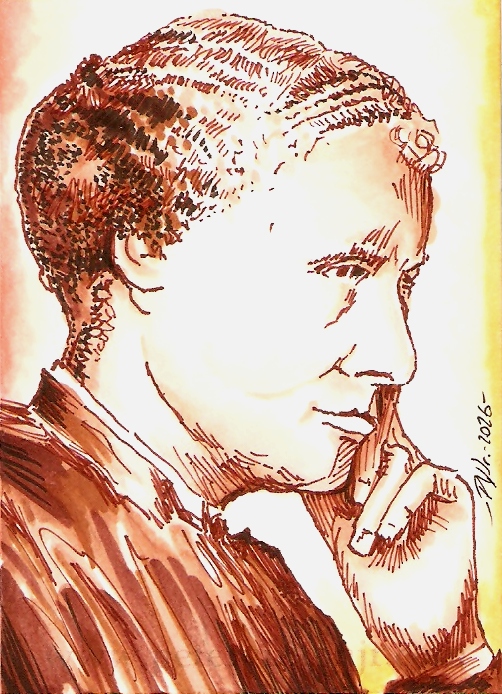
I'm willing to bet real money you haven't heard of Mary Ellen Pleasant, someone whose life story contains enough intrigue, suspense, and heroism to fill a trilogy of movies. Born into slavery (or at the very least, into a system closely connected to it), this unsung titan of abolition managed to quietly accumulate enough wealth to bankroll an entire civil rights movement decades before such a thing as a Civil Rights Movement could be said to exist.
Frustratingly, a lot of her early childhood details are either muddled, or just outright unknown. Even the place of her 1814 birth is disputed --either enslaved on a Georgia plantation or as a free woman in Philadelphia. She herself described her parents as a Black mother and a Hawaiian father, and though she never received a formal education, she did learn to read and write in Nantucket, Mass., and was a contemporary of William Lloyd Garrison.
In 1852 during the Gold Rush, Pleasant moved west to the newly-admitted state of California, and established herself as a restaurant investor; quietly putting multiple eggs into multiple baskets, so to speak. Among her entrepreneurships included boarding houses, additional restaurants, laundries, and assorted other properties all across San Francisco --eventually accruing a personal net worth of $30 million. (And that's in 1850's dollars.) But rather than showcase her wealth, she was equally stealthy about where it was spent: that is to say, to help people escaping slavery, funding legal challenges, and making connections to the various networks that fed into the Underground Railroad, including the efforts of William Still and the Pennsylvania Anti-Slavery Society (see Lesson #175 in this series).
Impossibly for the time, a Black woman found herself amongst influence and privilege within some of the most powerful political and business leaders in all of San Francisco, and she made excellent use of both her anonymity and her proximity. In 1866 Pleasant sued a San Francisco public transportation company after being forced off of a segregated streetcar, setting in motion legal challenges to segregation in California a full century before hi more well-known legal challenges would be brought. Perhaps her cleverest venture (and the reason this life story merits, in my opinion, an entire movie trilogy) was to pose as a housekeeper at the mansion of her business partner Thomas Bell --in reality she was the undisputed owner of the mansion, surreptitiously overhearing stock tips and guiding and directing her employees.
But indisputably, Pleasant's most significant financial project was the surreptitious funding of John Brown's planned raid on the armory at Harper's Ferry (covered at length in Lesson #116 of this series and elsewhere). Her role in bankrolling one of the most famous precursor events of the Civil War remained lost to history until she herself admitted to her participation, years later --in fact going as far as to insist that the words "friend of John Brown" be printed upon her grave.
Predictably, since society simply could not accept the idea of a Black woman being so independently wealthy and influential, Mary was sensationalized in the press as "the Voodoo Queen" (among other, far uglier nicknames), since such women were obviously immoral, manipulative, and dangerous. When viewed alongside her admission to helping John Brown, these hits to her reputation flipped over into outright character assassination and were, unfortunately, sufficient to ensure that her name largely stayed out of history books... until recently.
Once again the full scope of this amazing lady's achievements reaches far beyond what I am able to narrate here in the space of a few paragraphs; in fact the main reason there has been such a significant gap between this lesson and the previous one, was that there was just so much to study and absorb. Accordingly, here are some additional sources to help get you more familiar with the Mother Of Civil Rights in California:
Black Excellence: Mary Ellen Pleasant (a short video by Ashley The Barroness on her YouTube channel)
Mary Ellen Pleasant, Freedom-Fighting Entrepreneur by Lynn M. Hudson, an essay for the Gilder Lehrman Institute of American History (Fall 2024)
Mary Ellen Pleasant: The Haitian-descended abolitionist who built a fortune in 19th-century America by Bianca Silva for The Haitian Times, Feb. 3, 2019
Next lesson - Watch this space