An ongoing illustrative history study
This piece originally posted on 08/28/2026
Prelude | 222 | 223 | 224 | 225 | 226 | 227 | 228 | 229 | 230 >> | Email |
|---|
In Lesson #61 of this series I mentioned that, of all the featured speakers at The March On Washington For Jobs And Freedom in 1963, only one woman --Daisy Bates-- was formally on the agenda, but was only permitted to speak for perhaps three minutes... which was at least an improvement over what happened to Gloria Hayes Richardson (Lesson #136), who only managed a quick "hello" before her mic was cut. This obvious imbalance throws some uncomfortable light on the movement's deliberate exclusion of women. A similar erasure lay in the organization of that event --while history acknowledges the sheer scope of its planning and the vital roles played by Bayard Rustin (Lesson #5) and A. Philip Randolph (Lesson #68) in its execution... once again a woman's name has been left out of that equation, even though she objectively did most of the behind-the-scenes infrastructure work to actually make it happen, including the determined push to include Bates and Richardson on the roster.
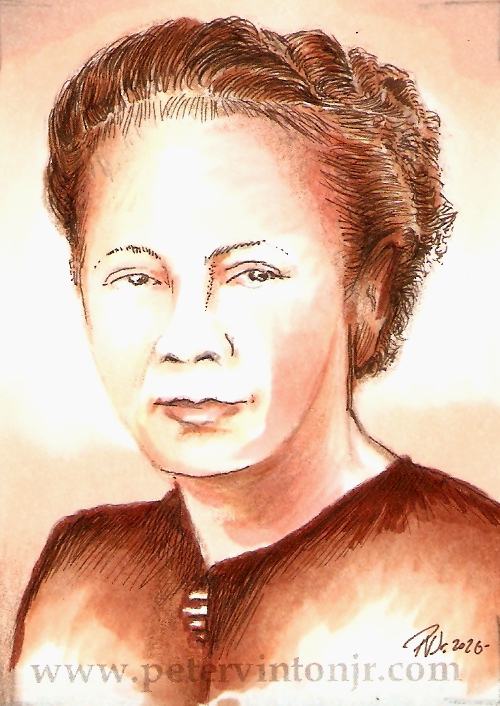
Today therefore let us make darned sure we celebrate the accomplishments of Anna Arnold Hedgeman: the practical organizer and back room strategist that the historians omit. Born in 1899 Iowa into a family that prized education and a strong work ethic, Anna graduated from high school in Anoka, Minnesota, and then went on to attend Hamline University in St. Paul, significantly becoming that school's first-ever Black graduate in 1922. Quiet and understated by nature and not given to attention-grabbing presentations, Anna was nevertheless inspired while at Hamline by a stirring guest speech by W. E. B. Du Bois and decided to become an educator herself. After teaching at Rust College in Mississippi for a time, Anna took a strong interest in civil rights and began a career with the Young Women's Christian Association (YWCA); by 1938 she would be directing and supervising five YWCA facilities (Springfield OH, Jersey City NJ, Harlem, Philadelphia and Brooklyn). During WWII she pulled off a similar multiple feat; serving as a civil defense official for New York, New Jersey, and Delaware.
Her understated, practical problem-solving approach thusly honed, she accepted an appointment to the National Committee for a Permanent Fair Employment Practices Commission, and in 1948 worked for the Harry Truman Presidential campaign, netting her a position in the Truman Administration as executive director of the National Council for a Permanent Fair Employment Practices Commission. In 1954 Anna became the first Black woman to serve in a New York City cabinet, under then-Mayor Robert F. Wagner Jr., where she advocated for labor issues, anti-poverty efforts, and women. She herself ran for City Council in 1948 but the campaign made little headway. She later travelled extensively with the Commission on Religion and Race of the National Council of Churches (NCC), which is where her orbit first intersected with Randolph's.
As the only woman on the March On Washington's planning committee, Anna Hedgman not only laid out the structure and the logistics, but coordinated virtually all of the public outreach necessary to build support for the day's events --that is to say, the one who "worked the phones" after everyone else had knocked off for the day; the one who made all the appointments, met with countless church leaders, and attended all the community events. Her association with the Commission of Religion and Race of the National Council of Churches, enabled her to personally recruit some 40,000 Protestant attendees. Despite Hedgman having been relegated to the background, the event of course went ahead and made history, reaching a larger audience than anyone could have hoped. Hedgeman's work was nowhere near done after the March; among other accomplishments she was one of the co-founders of the National Organization for Women (NOW) in 1966. That same year her signature appeared on the full-page Black Power Statement that famously ran in the New York Times --once again, as the only woman. Throughout the 1970s and into the 1980s she --along with her husband Merritt-- created and administered the Hedgeman Consultant Service: advising on race issues for schools, churches, and municipalities. Anna died in 1990 after more than seventy years of civil rights work: nearly all of it having been out of the spotlight.
Hedgemen penned two autobiographies in her lifetime: The Trumpet Sounds (1964), and The Gift of Chaos (1977). In 2011 Hamline named its Center for Student Diversity Initiatives and Programs in her honor. And even her old high school in Anoka, MN, spearheaded an initiative to rename its library the Anna Arnold Hedgeman Library.
For further reading: Until There is Justice by Jennifer Scanlon. New York: Oxford University Press, 2016
Next lesson - Watch this space