An ongoing illustrative history study
This piece originally posted on 02/22/2026,
Black History Month 2026
Prelude | 208 | 209 | 210 | 211 | 212 | 213 | 214 | 215 | 216 | Email |
|---|
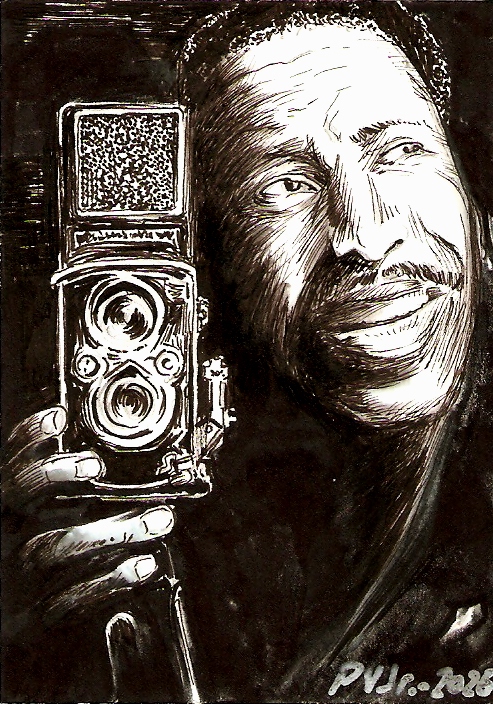
"I saw that the camera could be a weapon against poverty, against racism, against all sorts of social wrongs. I knew at that point i had to have a camera."
You are almost certainly familiar with some of the works of photojournalist Gordon Parks, though you may not necessarily recognize his name. Born in 1912 Kansas, Parks attended a segregated elementary school that aggressively discouraged Black students from pursuing higher education. Parks's mother Sarah died when he was 14, and he left home pursuing a variety of jobs and opportunities. A chance exposure to a riveting photo essay about migrant workers, inspired him to look into photography as a calling; he purchased his first camera at the age of 25 and entered the business as a fashion photographer in Chicago.
Parks's creativity soon branched out beyond fashion, however, and his provocative work caught the eye of the Farm Security Administration; in particular Parks's 1942 photo of Ella Watson, a Black cleaning woman in Washington, D.C., became famous as a symbol of inequality in America. Parks also did freelance work for Vogue magazine --the first Black American to land such a job. In 1948 he also became the first Black man to work at Life magazine --at the time arguably the single most popular mainstream news/current events magazine in America-- and his work put a spotlight on the crushing toll of poverty and racial segregation, and caught the attention of that magazine's predominantly white readership. Parks would work for Life for 25 years, publishing powerful photo essays about segregation, making the realities of poverty and inequity impossible to ignore.
In 1969 Parks notched another first: directing a film adaptation of his own book The Learning Tree. He also wrote the screenplay and composed the soundtrack. His next film, Shaft starring Richard Roundtree, was one of 1971's biggest box-office hits and spawned several sequels and might be safely said to be the starting point of blaxploitation as a film genre.
Next lesson - Lesson 213: Maurice Sorrell