An ongoing illustrative history study
This piece originally posted on 05/02/2026
Free Comic Book Day 2026
Prelude | 216 | 217 | 218 | 219 | 220 | 221 | 222 | 223 | 224 | Email |
|---|
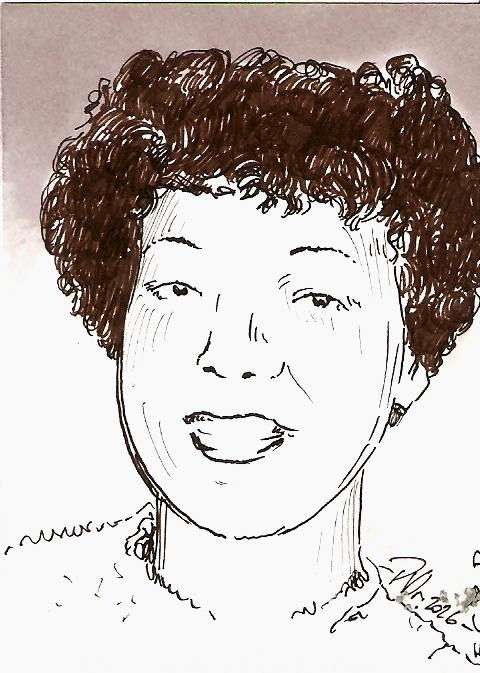
Happy Free Comic Book Day everyone. And in honor of this most blessed of holidays, today I want to tell you all about the life's work of Jackie Ormes, creator of the Torchy Brown character, Patty Jo 'n' Ginger, and Candy. These specific characters and their affiliated strips may not be familiar to you, but they are in fact the handiwork of America's first-ever published --and first-ever syndicated-- Black cartoonist.
Born in 1911 Pittsburgh, Jackie's parents William Winfield Jackson and Mary Brown Jackson owned a movie theater and a printing business, which almost certainly helped to set the stage. In 1930, after graduating high school, Jackie took a job as a proofreader and art director for the Pittsburgh Courier, during which she also contributed editorials and various freelance pieces. Later Jackie married hotel manager Earl Ormes in 1936 --they had one daughter, Jacqueline, who tragically died at the age of 3.
During her time with the Courier Jackie also began experimenting with cartoons alongside her editorial pieces, and in 1937 she premiered her first regular strip: Torchy Brown in Dixie to Harlem. The lead character, Torchy, was a definite standout --fashionable and intelligent, flying in the face of Black depictions in popular culture. No racist caricatures here --Torchy was a headstrong, glamorous teenager from Mississippi who traveled to Harlem to perform at the Cotton Club, and while the strip was still mostly humour-based, there was a grounding in the real-life day-to-day struggles of Black people.
The strip ended after a full year run, but Jackie soon returned to cartooning; producing Candy, a single-panel "daily gag" cartoon for The Chicago Defender (a newspaper which has been mentioned often in these recent journalism-focused biographies). Ormes wrote other think pieces for the Defender during this time, making observations on civil rights and other sociopolitical issues --usually with generous helpings of satire. Of course there was a downside to this growing popularity: the FBI did open a file on Ormes at some point during the McCarthy Era in its never-ending "communist" witch hunt. In 1942 Ormes returned to the Courier with a new premise: the two sisters Ginger 'n' Patty Jo. This series ran for eleven years and became so popular it led to the creation of a "Patty Jo" doll --the first Black doll based on a comic character, complete with combable hair and a considerable wardrobe (sold separately). It is widely thought that Patty Jo's precocious, thoughtful behind-the-scenes narrative --usually at the expense of her older (but not necessarily wiser) sister Ginger-- was inspired by Jackie's deceased baby daughter. In the 1950s Ormes brought back Torchy for a new series, Torchy in Heartbeats.
In January of 2014, nearly 30 years after her death, Jackie Ormes's work enjoyed something of a revival and she was inducted into the National Association of Black Journalists' Hall of Fame. Pick up a copy of Jackie Ormes: The First African American Woman Cartoonist by Nancy Goldstein. Or, if you'd prefer to read something a little more artistically attuned to today, thumb through a copy of Holding Her Own: The Exceptional Life of Jackie Ormes by Traci N. Todd and very appropriately illustrated by Shannon Wright.
Next lesson - Lesson 221: Rep. Joseph Rainey