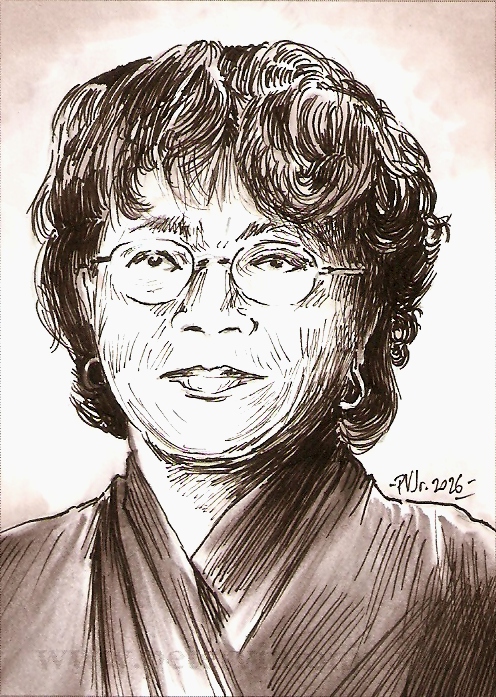
An ongoing illustrative history study
This piece originally posted on 10/13/2026,
what would have been Ms. Davis's 94th birthday
Prelude | 227 | 228 | 229 | 230 | 231 | 232 | 233 | 234 | 235 >> | Email |
|---|
"Don't be afraid of the space between your dreams and reality. If you can dream it, you can make it so."
It has been just a little over a year since we bade farewell to broadcasting titan Belva (Belvagene) Davis, the first Black woman to become a television reporter on the U.S. West Coast. I was entirely ignorant of this multiple Emmy-winner and her contributions to journalism; I hereby correct that with this celebration of her life and accomplishments. Born in 1932 Louisiana but raised in Oakland, California, Belva Melton's family eventually settled in Berkeley, and she became the first member of her family to graduate from high school. She took a job as a clerk-typist at the Oakland Naval Supply Depot (don't even ask what kind of meager salary that translated into, those years).
In 1957 a chance freelance writing assignment for Jet magazine led into multiple such submissions, eventually feeding into a gig as an on-air interviewer and "clip-reader" for KSAN-AM. In 1960 she pivoted to Oakland-based KDIA, doubling as an honest-to-goodness disc jockey and also hosting an in-studio interview show. In 1964 she covered the Republican National Convention (Barry Goldwater's nomination), one of very few Black journalists to be invited --and definitely not made to feel welcome; she and several of her Black colleagues were at one point chased out of the venue. That same year she was invited by rival news station KNEW to host a weekend show which soon became The Belva Davis Show. This and a slate of public service announcements earned her the nickname "Miss KNEW."
Her talents were in demand at multiple news outlets; two years later Davis was brought on as an anchor at San Francisco's KPIX-TV, making her the first Black woman television reporter on the west coast. While at KPIX she created and hosted All Together Now, an early prime-time public affairs program that gave greater focus to local communities. She covered the Berkeley riots, the Black Panthers, Jonestown, and the assassinations of George Moscone and Harvey Milk. In 1977 Davis pivoted to KQED, a PBS station; anchoring A Closer Look and then Evening Edition. A lengthy stint with KRON-TV followed, and then in 1990 she launched a news analysis series This Week in Northern California, which would run for an impressive 24 seasons.
Over the course of her career Davis would go on receive eight Emmy Awards. She received Lifetime Achievement honors from the American Women in Radio and Television, and the National Association of Black Journalists (mentioned more than a few times in recent lessons in this series). She published her memoir, My Wildest Dreams: A Black Woman's Life in Journalism, in 2011.
"Belva knew instinctively how to keep everyone in check. Amid all these prima donnas, she had so much class, so much presence, so much intuition. Belva has always been the grande dame." --journalist Rita Williams, KTVU
Next lesson - Watch this space