An ongoing illustrative history study
This piece originally posted on 10/06/2026
Prelude | 226 | 227 | 228 | 229 | 230 | 231 | 232 | 233 | 234 >> | Email |
|---|
"I covered good news for years. But it was news none the less. It was what Black people felt was important to them. These are successful people who had the same obstacles placed in their way as others, but instead of complaining, or finding excuses they went out and did something about it. They didn't allow racism and prejudice to hold them back; they fought the odds and won."
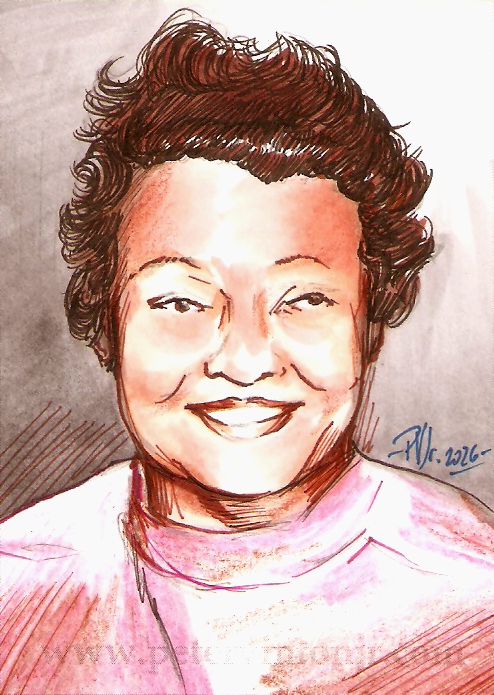
For our next groundbreaking journalist, we reflect on the remarkable story of Hazel B. Garland, the first Black woman to serve as editor-in-chief of a nationally circulated newspaper chain.
Born in 1913 Terra Haute, Indiana, Hazel Hill's family was faced with a decision so many Black families had to make: they could only afford to send one sibling to school and that ended up being one of her younger brothers. Hazel, a self-admitted "bookworm," also had an amazing talent for music and in 1935 she married a fellow musician, Percy Garland --by all appearances seemingly resigned to a role of housewife. Some seemingly-innocuous community participation and involvement in volunteer organizations, however, led to a latent enthusiasm for writing: freelance reporting on small, neighborhood events and sending those accounts along to the New Pittsburgh Courier --a prominent Black-owned and Black-focused periodical previously touched upon in Lesson #81, Lesson #171, and Lesson #220 of this series. In 1943 she was actually hired by the Courier as the 'Women and Society' writer for the city edition.
Hazel was elevated to associate editor in the mid-1950's, with the enthusiastic support of the senior editorial staff, as she demonstrated a willingness to cover harder-hitting topics. One of her ongoing series, The Three I's: Ignorance, Illiteracy and Illegitimacy, won the prestigious Page One Award in 1953. The paper fell into financial trouble in the mid-1960's but was rescued by John Sengstacke, then-publisher of the Chicago Defender. In 1970 Hazel was again promoted to be the Courier's first woman city editor, and then finally to full Editor-in-Chief in 1974.
"We tell the stories," Garland would later explain in a 1987 interview. "We tell the stories of the people. We told the stories of Colored people, we told the stories of Negroes, we told the stories of Black people and now we tell the stories of African-Americans. Does it really matter, sports, social, entertainment, or political? They are all our stories, and if we don't tell it, who will?" Garland retired from the Courier in 1977 but continued to contribute to two of her own long-running columns: Video Vignettes and Things To Talk About, both of which had been mainstays since the 1950's. Hazel died in 1988.
"Without her the Courier would have folded during that period when Sengstacke came in. Under her it became a better-prepared product. She didn't appreciate making mediocrity respectable. Hazel was one of two top women in journalism, the other being Ethel Payne of the Chicago Defender." --journalist Frank E. Boulden
As comic-con season wraps up, I very much need you to take a close look at the works of Karla Medrano, perhaps also known to you as Moon_the_Storyteller on various social media platforms. Medrano is the author/creator of Luna, the Queen of Mahru, under Blaq Girl Comics. Go pick up some of her work or just check out a blog entry or two. I have learned so much from her and it has been humbling.
Next lesson - Watch this space